Electric Kool Aid Acid Test . In the 1960s, kesey led a group of psychedelic. It looks like you're offline. Pin by Jonathan Cross on Skull Art Album art, Pulp art, Skull art from www.pinterest.com Tanned pages and age spots, however, this will not interfere with reading. Although the merry pranksters were dead, however, pranksterism had a. This is the seminal work on the.
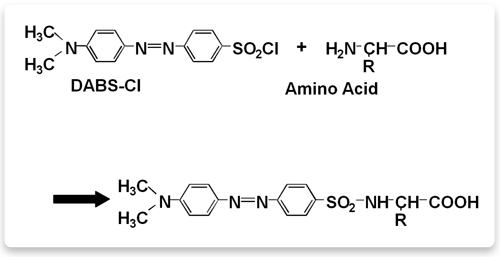
Dabsyl Chloride Reaction With Amino Acid. A peptide composed of amino acids does not react with dabsyl chloride with phenyl isothiocyanate. Dansyl chloride readily reacts with primary and secondary amino groups of amino acids.
Analysis of Dabsyl Amino Acids using HPLC JASCO from jascoinc.com
Acid chlorides are very reactive, and they readily react with ammonia, primary amines, or secondary amines to form an amide. For imino acids, the absorbtion happens at 440nm. An aliquot of this dabsylated amino acid solution is analyzed on a mubondapak c18 column with ethanol/sodium acetate (20 mmol/l, ph 4.0) 4/6 (by vol.), as mobile phase.
Phenyl Isothiocyanate Reacts With The Uncharged Terminal
The route is simple, efficient, and affords good yields of products. These include fluorescamine, dansyl chloride, dabsyl chloride, etc., used in the detection of trace amounts of amino acids at the nanogram level. The second stage (the elimination stage) happens in two steps.
The First Stage (The Addition Stage Of The Reaction) Involves A Nucleophilic Attack On The Fairly Positive Carbon Atom By The Lone Pair On The Nitrogen Atom In The Ethylamine.
An aliquot of this dabsylated amino acid solution is analyzed on a mubondapak c18 column with ethanol/sodium acetate (20 mmol/l, ph 4.0) 4/6 (by vol.), as mobile phase. Hplc determination of bioactive sulfur compounds, amino acids and biogenic amines in biological specimens. The rate of hydrolysis of dansyl chloride is constant and low up to ph 9.5 and above this ph it increases rapidly.
Furthermore With Respect To Opa Derivatization, Dabsyl Chloride Can React With Primary And Also With Secondary Amines[1].
In the quantitative estimation of amino acid using ninhydrin reagent, the absorbance of the ruhemann's purple formed by the reaction at 570nm is measured. 50 μl of reaction buffer and 100 μl of 15 mm dabsyl chloride are added to the tube and derivatized. The exemplary protocol is as follows:
The Various Reactive Groups Of Amino Acids And Peptides React With Dansyl Chloride In Their Unprotonated.
Also a simply a uv/vis detector can be used with high Dansyl chloride readily reacts with primary and secondary amino groups of amino acids. A peptide composed of amino acids does not react with dabsyl chloride with phenyl isothiocyanate.
Chlorination Of Amino Acids Can Result In The Formation Of Organic Monochloramines Or Organic Dichloramines, Depending On The Chlorine To Amino Acid Ratio (Cl:aa).
Dabsyl chloride is an amine derivatizing agent, able to give rise to stable products that can be easily monitored spectrophotometrically at 460 nm; 6 it can be seen that the reaction rate k2 (glycine). For imino acids, the absorbtion happens at 440nm.


Comments
Post a Comment